
The Real Cost of Washing Dishes in a Commercial Kitchen
Most operators think warewashing is a labor issue. It's actually a five-category system — and each one is manageable once you know what you're looking at.
Why this number is bigger than you think
Industry data consistently shows warewashing costs represent 3–5% of total food service revenue. In a restaurant doing $2 million a year, that's $60,000–$100,000. Most operators couldn't tell you that number without digging through three different P&L departments.
3–5%
of revenue
Warewashing's share of total food service revenue
$60K+
annual exposure
In a $2M restaurant — often hidden across 3 P&L departments
5
cost categories
Each measurable, manageable, and interconnected
Where The Money Actually Goes
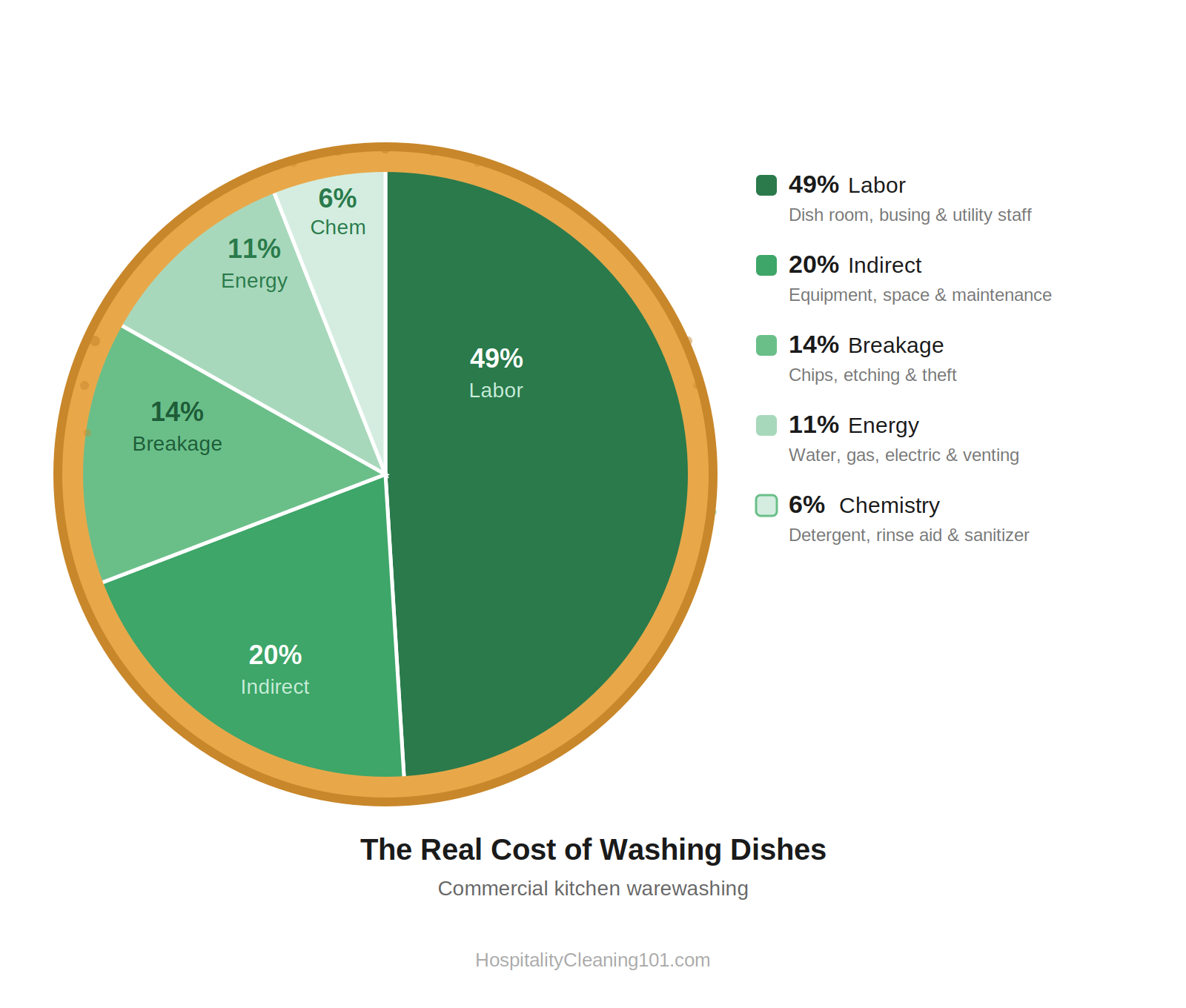
Breaking it down, category by category
49%
Labor — The Biggest Line Item Nobody Manages Well
Dish room staff, bussers, utility personnel, wages, and benefits
The biggest driver of wasted labor is the multi-pass wash cycle. One-pass washing isn't just an efficiency metric — it's a discipline that requires proper scraping stations, organized dish flow, and trained staff. Train your dish room team the way you train your line cooks. They're running equipment that costs more than most of your kitchen smallwares combined.
20%
Indirect — The Silent Budget Drain
Machine depreciation, lease costs, PM contracts, space allocation, HVAC
Preventive maintenance is the highest-leverage investment in this category. A properly serviced machine runs cleaner, faster, and lasts significantly longer. Calcium and lime scale buildup on spray arms forces re-washing. A de-liming program and quarterly inspections will save more than the service contract costs
14%
Breakage — The Cost That Hides in Plain Sight
Chipped plates, etched glassware, theft, and attrition from poor handling
Breakage is treated as inevitable — a cost of doing business — despite the fact that a significant portion is preventable. The biggest culprits are wrong rack types, over-stacked racks, and poor handling on the unload side. Glassware etching is a chemistry and temperature issue as much as a handling issue. That's not a broken glass you see on the floor; it's a clouded glass you throw out three months from now after a guest complaint.
11%
Energy — Every Degree Costs Money
Water consumption, sewage, natural gas or electric heat, ventilation
NSF standards specify water usage per rack for a reason. A machine using 30% more water per cycle than spec isn't washing better — it's costing more. High-temp machines need a booster heater to reach 180°F in the final rinse. If it struggles, you're either not sanitizing properly or overworking the element. Both outcomes are bad.
6%
Chemistry — The Most Misunderstood Slice
Detergent, rinse additive, and sanitizer
Chemistry is the smallest slice of the pie, but it has the biggest impact on the other 94%. Peristaltic pumps drift — a pump calibrated correctly at installation may be off by 20–30% a year later, unnoticed. Test your sanitizer concentration. Test strips cost almost nothing; not testing is a food safety issue first and a cost issue second.
“The best-run dish rooms I've seen in 40-plus years in this industry have a few things in common: they're treated as production environments, not afterthoughts. They have defined procedures. Equipment is maintained on a schedule, not reactively. And the people running them have been trained—not just put on the line and told to keep up.”
— Jerry Bauer, HospitalityCleaning101.com
Where to start today
01
Audit your one-pass washing rate
Pull a shift's worth of rack counts and compare to re-runs. If more than 10–15% of racks are going through twice, you have a pre-scraping and loading problem.
02
Calibrate your dispensing equipment
Call your chemical rep — this should be part of any service agreement — and have them verify concentrations with titration, not just visual inspection.
03
Pull your utility data
Look at total restaurant energy per cover month-over-month. Spikes almost always trace back to equipment issues you weren't aware of.
04
Do a rack inventory
Are you using the right racks for the ware you're washing? Flatware in a glass rack is one of the most common and easiest-to-fix breakage drivers.
05
Count your smallwares against purchase history
You may find the inventory shrinkage problem faster than expected — and identify whether you have a drift problem or a discipline problem.
Need help with your dish room?
Reach out directly — whether you're an operator troubleshooting costs or a supplier looking to reach the hospitality market.
HospitalityCleaning101.com
Jerry Bauer
40+ years in hospitality cleaning and sanitation · Author, Pour with Pride · Host, Cleaning Processes with Jerry (Buzzsprout) · HospitalityCleaning101.com
Actionable Insight From Inside the Cleaning Supply Chain
Join industry leaders who receive practical guidance on distributor expectations, product positioning, and market shifts shaping the cleaning industry. Each edition delivers clear, experience-driven insight you can apply immediately.
Copyright 2026 , all rights reserved.